All Things Plants

The Arisaemas Database, moderated by eclayne

We have 112 images of 248 plants listed.

Search and Browse Actions
» Browse the full list of arisaemas (or see recent additions)

» Search by characteristics

» Access the general Arisaemas entry

New images
Cobra Lily (Arisaema ringens), by eclayne
Image
Japanese Cobra Lily (Arisaema sikokianum), by robertduval14
Image
Japanese Cobra Lily (Arisaema sikokianum), by robertduval14
Image
Whipcord Cobra Lily (Arisaema tortuosum), by eclayne
Image
Whipcord Cobra Lily (Arisaema tortuosum), by eclayne
Image
Cobra Lily (Arisaema nepenthoides), by eclayne
Image
Cobra Lily (Arisaema ringens), by eclayne
Image
Cobra Lily (Arisaema nepenthoides), by eclayne
Image
Japanese Cobra Lily (Arisaema sikokianum), by eclayne
Image
Japanese Cobra Lily (Arisaema sikokianum), by eclayne
Image
Japanese Cobra Lily (Arisaema sikokianum), by eclayne
Image
Whipcord Cobra Lily (Arisaema tortuosum), by eclayne
Image
Whipcord Cobra Lily (Arisaema tortuosum), by eclayne
Image
Jack-in-the-pulpit (Arisaema triphyllum), by gardengus
Image
Jack in the Pulpit (Arisaema consanguineum), by robertduval14
Image
Jack in the Pulpit (Arisaema consanguineum), by robertduval14
Image
Cobra Lily (Arisaema ringens), by robertduval14
Image
Cobra Lily (Arisaema ringens), by robertduval14
Image
Cobra Lily (Arisaema ringens), by robertduval14
Image
Japanese Cobra Lily (Arisaema sazensoo), by robertduval14
Image
New comments
Talking about Cobra Lily (Arisaema flavum subsp. flavum), valleylynn wrote:

Grow in cool sun to part shade in well-drained fertile, evenly moist soil. Arisaemas are tuberous perennials that die back to the ground in winter. Arisaema flavum emerges from late spring into summer. It is one of the toughest and easiest Arisaemas to grow. Hardy to -20 degrees F. Found in open, rocky areas of the Himalayas from Afghanistan to SW China at 6,000 to 15,000 ft.
http://www.wildgingerfarm.com/store/arisaema-flavum/
Talking about Griffith's Cobra Lily (Arisaema griffithii), jmorth wrote:

Tubers are an important winter food for people of Sikkam in India.
Harvesting is only allowed for a week; plant's status is monitored by the forest department.
Talking about Japanese Cobra Lily (Arisaema sikokianum), SongofJoy wrote:

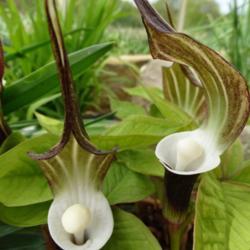
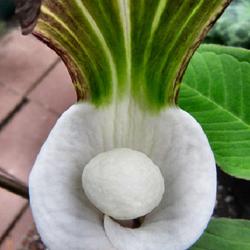
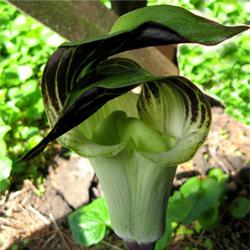
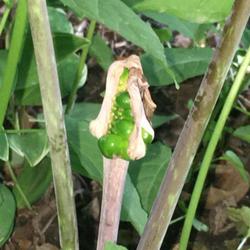
The flower is composed of a pure white spadix, or Jack, that looks like a big puffy marshmallow and is surrounded by a pitcher that is glowing white inside and dark purple/black on the outside with a dark striped hood. Single flower stalks come up in mid-spring with a pair of 5-lobed glossy green leaves reaching about 12 to 20 inches tall. Unlike many other Arisaemas, the foliage stays up all summer. If the flowers were pollinated (you need at least 2 plants), you may see bright red berried fruits in late summer.

Japanese Cobra Lily prefers partial to full shade and moderate to moist soil during the growing season. Excessive winter moisture is death to these plants.
Talking about Cobra Lily (Arisaema ringens), SongofJoy wrote:

Japanese Cobra Lily is a very elegant cousin of Jack-in-the-Pulpit. The flower is composed of a thick purple and white striped spathe that curls down resembling a cobra's head. The spadix, or Jack, is dark purple. Single flower stalks come up in mid-spring below a pair of giant, 3-lobed glossy, thick, green leaves reaching about 12 inches tall. Unlike many other Arisaemas, the foliage stays up all summer. Although it is very easy to grow, excessive winter moisture is death to these plants. In time, they may form large clumps. (Sunlight Gardens)
Talking about Greendragon (Arisaema dracontium), SongofJoy wrote:

Green Dragon is similar to Jack-in-the-Pulpit in its general form and structure, but it is a much more dramatic looking plant. A stout single leaf divided into 7 to 15 leaflets which spread a foot or more in width and may grow up to 3 1/2 feet tall. From its base, a green and brown mottled flower stalk rises in late spring with the same spathe and spadix structure as in Jack-in-the-Pulpit. The spadix is long and twists snake-like up through the leaflets of the plant. The effect is exotic, but this plant is fully hardy and will do well in light shade and rich, moist soil. Plants die back down to the ground right after flowering unless they make berries but emerge again in mid-spring.
Talking about Jack-in-the-pulpit (Arisaema triphyllum), jmorth wrote:

A fairly common wildflower in Illinois found in moist woods settings flowering in April and May.
Flowers wrapped in a tube-like green sheath termed a spathe, folds over the flower top. Inside the spathe, flowers are crowded together along lower end of spadix (cylindrical brown or green column).
Cluster of shiny orange-red fruit evident in the fall.
Indians used the corm to treat sore eyes (Chippewas). Pawnee Indians used a powder prepared from corm and applied it to the head or temples to relieve headache. Corm also utilized in the treatment of snakebite, ringworm, gas, rheumatism, and asthma. Indians also used the corm, after boiling or baking (thereby neutralizing the unpleasant reactivity of the calcium oxalate crystals) for food.
Talking about Jack in the Pulpit (Arisaema consanguineum), JRsbugs wrote:

I had this for several years, kept in a large pot in a cold greenhouse. I grew it in a good gritty 'river soil' mixed with lots of leafy compost. It can survive very low temperatures in the UK and produced a spathe reliably every year, although a repot occasionally is advisable to give it a boost with fresh compost. It is later to show than many other Arisaemas, it will place itself very deep in a deep pot so don't panic if it's slow to show although I have at times scratched down to see if all is well you have to be careful not to knock off it's new growth tip.

I had never fed it as it got sufficient nutrients from the compost and I believe artificial feeding can often reduce hardiness. It managed to get through a very cold winter in the UK in 2009/10 but the winter of 2010/11 was an exceptionally cold winter with temperatures below freezing continually for 7 weeks dipping as low as -17C, that killed it! Worth another try though!
Talking about Jack-in-the-pulpit (Arisaema triphyllum), SongofJoy wrote:

Does poorly in heavy clay soil. Needs constantly moist soil that is rich in organic matter.
Talking about Greendragon (Arisaema dracontium), jmorth wrote:

Single leaf; highly dissected w/ deep narrow lobes is attached to smooth green stalk. Leaf divided into odd number of segments (5-15) each one lance shaped up to 10" long and 4" wide. Segments are smooth, without teeth. Flowers branches off from leaf stalk near base and are wrapped in a tubular green sheath (spathe). Inside the sheath, flowers are crowded along a column (spadix),. emerging therefrom a tail-like green cylindrical column to 7" long.(the tail).
A cluster of shiny orange-red fruit develops therefrom in the fall.
Indians dried the corm and used it for food. Without the drying, eating would render one's mouth an intense burning pain due to the presence of calcium oxalate crystals.
Green dragons are found in moist woods and are not uncommon (in Illinois).

Or

Username:

Password:

[ Join now ]